Three-Sine Portable Power builds construction-rated wheeled power stations purpose built to run induction motors pulling large loads, using lithium-iron-phosphate battery power. Three-Sine Power Stations fit through door frames and are designed to withstand job site abuse.Three-Sine Power Stations can deliver up to 26 max kW of split and single-phase, or 19.5 max kW of 208 volt 3-phase AC power for up to 100 kWh.The stations easily add to their base capacity by pairing with portable 10, 30, or 60 kWh battery module units. Build a fleet of battery modules to give your team unlimited capacity for powering your job site.Three-Sine operates from and manufactures in Philadelphia, Pennsylvania. We are proud to help power the American construction market from America's birthplace. Call Three-Sine today and talk to us about custom receptacle suites and personalized unit branding.

WHAT IS POSSIBLE

What is possible with Three-Sine Portable Power Stations?We sell the products primarily to commercial and industrial contractors because that is where we are able to drive the most value into the market. The induction motors that run concrete grinders and saws are no joke. They rip like hell at inrush, and they need dedicated clean sine waves to get the job done.But think about it; if we purpose-built a power station to run something made by Husqvarna that destroys and forms concrete at scale, what else can you do with it?We are honestly asking the question, and we hope you take seriously the idea that the answer is"Whatever the hell I want with it!"And that is really why Three-Sine exists. There is demand today to run induction motors indoors for commercial construction and large sound and lighting rigs for production crews.The demand for Three-Sine products tomorrow will come from someone reading this. Someone who looks at our products and doesn't think "Cool for a flooring contractor!", but instead is the type of person that is constantly challenging themselves.That person looks at a Three-Sine Portable Power Station and thinks one thing:"My dream needs that to happen"Plain and simple. We make steel and iron boxes that allow you to harness electricity and bend the physical world to your will.You now get to decide what is possible. So please, show us...
THREE-SINE PRODUCTS
Three-Sine Portable Power Stations provide Alternating Current for their users.The principal specifications for Three-Sine Portable Power stations are each 3S model's max kilowatt (kW) output for any given moment, and the runtime capacity of the system.Battery capacity for Three-Sine systems is measured in terms of kilowatt-hours (kWh). The headline number indicates the number of hours the station can generate 1 kilowatt of output. The 15 kWh prototype will output 5 kW for 3 hours. The flagship 3S-26 runs the same load for 8 hours. A 3S-26 connected to a BM-60 will run that load for 20 hours.Battery modules are connected via Anderson 350 DC ports on the broadside of each Three-Sine product. Each module is provided with an Anderson 350 connector cable.To add capacity, simply wheel a module alongside your main Three-Sine station, power down your station, and use the cord to connect each unit's Anderson port. The inverter system will automatically read the additional capacity upon restart, and you are ready to continue using your equipment.
SPECIFICATIONS
* Actual plated kWh values exceed marketed values shown here.
** 208v 3Φ Capable.
*** 19.5 max kW output 208v 3Φ, 6.5 max kW 120-volt runs simultaneously.
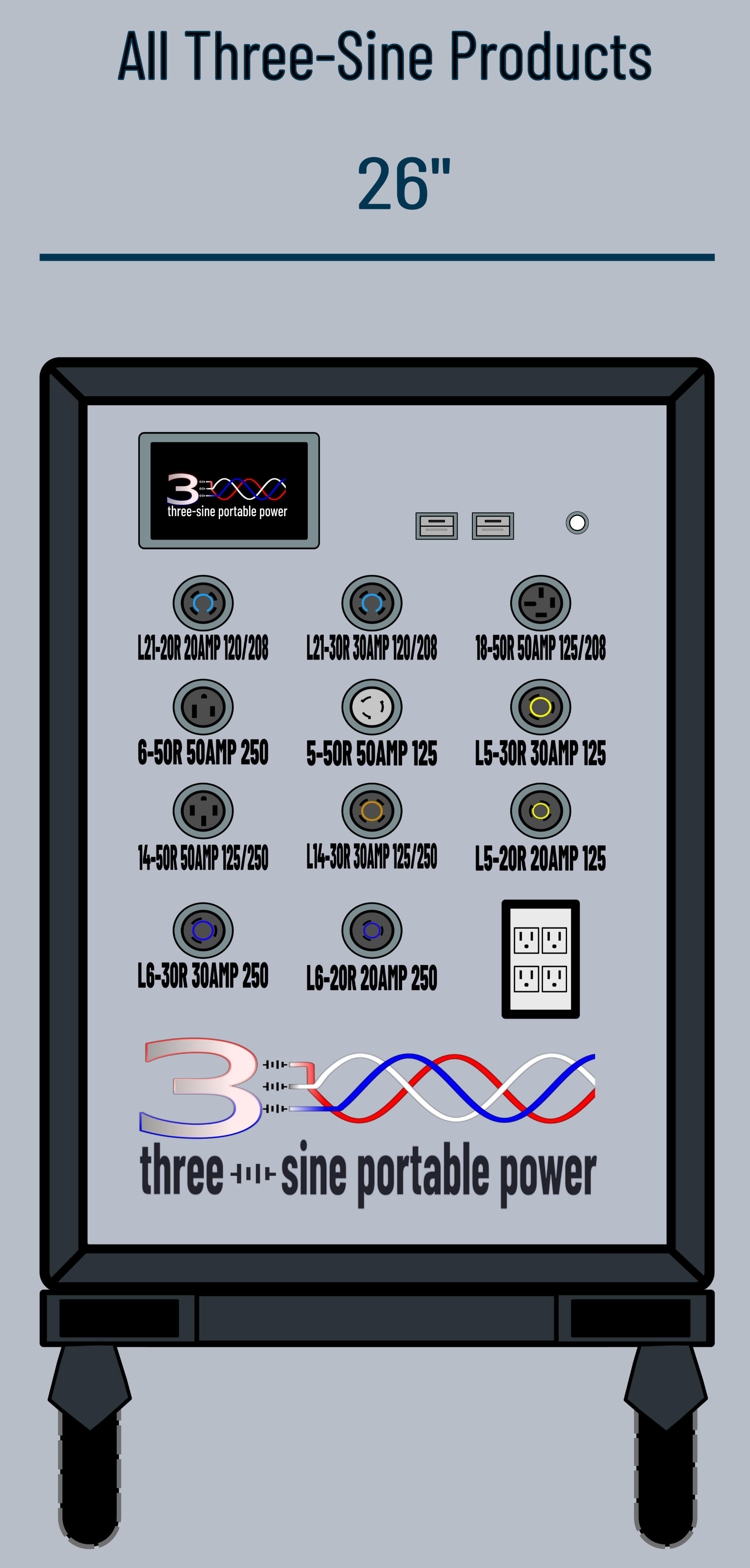
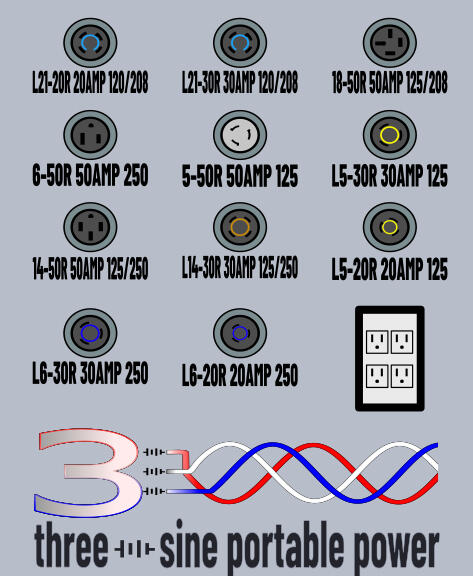
* Image shows complete Three-Sine receptacle family for demonstration purposes. See MODEL LAYOUTS for individual unit suiting.
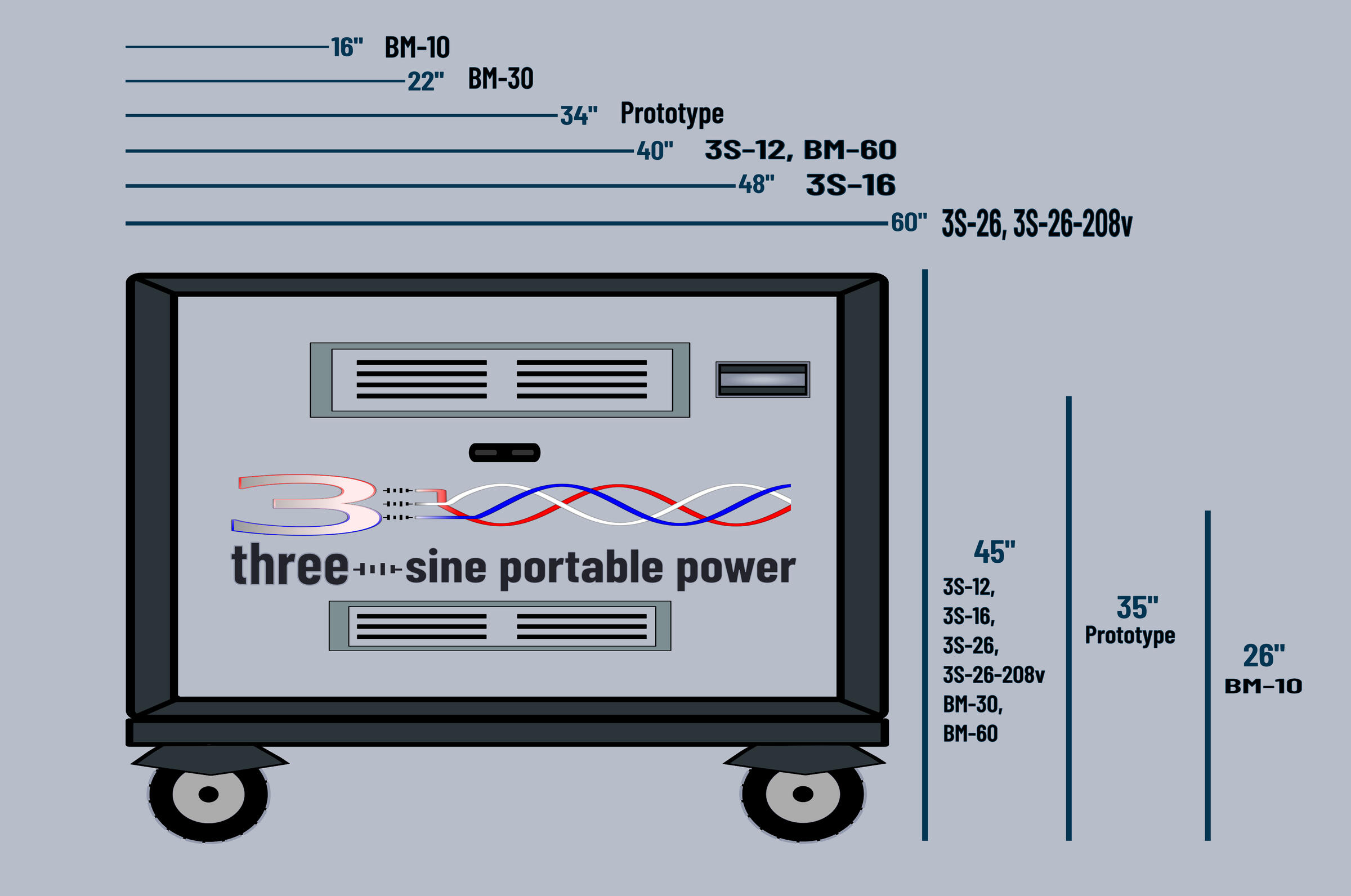
Height and depth dimensions of every Three-Sine Portable Power product.
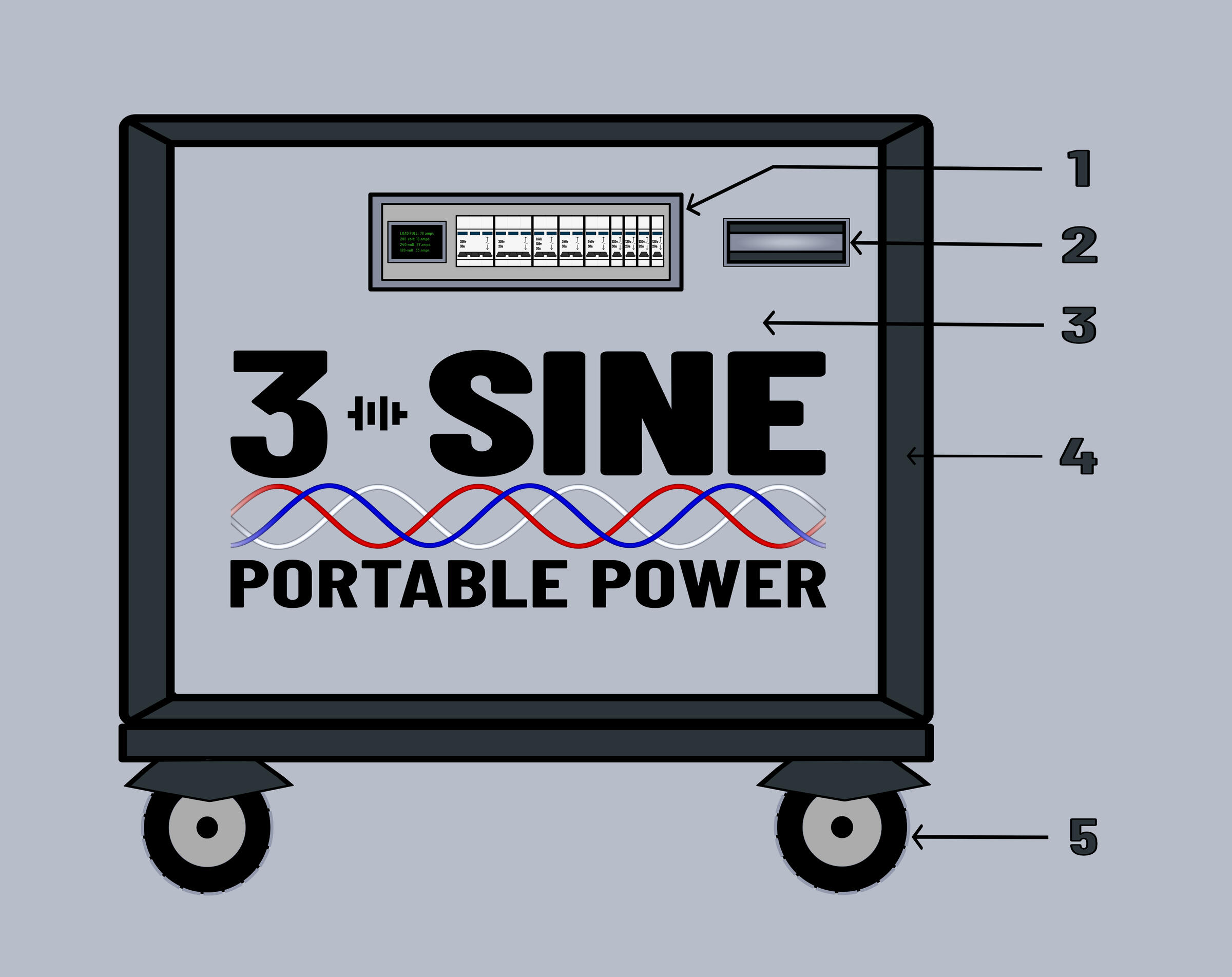
1. Siemens UL489 Miniature Breakers.
2. Recessed handles
3. 14-gauge steel paneling reinforced and insulated with neoprene padding on each side.
4. 11-gauge slightly-rounded, angled iron framing.
5. Heavy-Duty casters. Fixed-rear, swivel-front.
Three-Sine 3S power stations standardize on ergonomically sound 45" heights and 26" widths - ideal for fitting through any size entrance way. Fork pockets are built in to the iron base-frame and heavy-duty casters rated to at least 3x each unit's weight are flanged to the underside. Dimensional differences occur in the depth of each product's enclosure (shown below as its length in inches), and the unit's weight.Three-Sine stations are engineered to offer the full range of standard split-phase RMS voltage values from 110-250 with dedicated 240 volt, split, and 120 volt receptacles. The 3S-16 and 3S-26-208v stations are capable of outputting 3-phase power in a 208 volt structure. On all Three-Sine products the sine waves are produced with a total harmonic distortion between 2 and 3%.
| Product | Capabilities | Dimensions |
|---|---|---|
| Prototype | 240v | split | 120v | 15.36 kWh | H: 35" | L: 34" | Wt: 440 lbs |
| 3S-12 | 240v | split | 120v | 20.48 kWh | L: 40" | Wt: 550 lbs |
| 3S-16 | 208v* | 240v | split | 120v | 30.72 kWh | L: 48" | Wt: 790 lbs |
| 3S-26 | 240v | split | 120v | 40.96 kWh | L: 60" | Wt: 1090 lbs |
| 3S-26-208v | 208v* | 120v** | 40.96 kWh | L: 60" | Wt: 1090 lbs. |
| BM-10 | 10.24 kWh runtime | H: 26" | L: 16" | Wt: 220 lbs |
| BM-30 | 30.72 kWh runtime | L: 22" | Wt: 600 lbs |
| BM-60 | 61.44 kWh runtime | L: 40" | Wt: 1050 lbs |
* 3Φ
** Runs simultaneously with 3Φ
MODEL LAYOUTS
Each model is displayed below with its standard receptacle layout. For no additional charge, Three-Sine allows customers to fit available receptacles with their fleet's plug-ends. On the CUSTOMIZE page; information is given on how you tell us what you want stacked in the load center, and what to put on the face.Three-Sine Portable Power Stations are designed to deliver large loads via sine waves with lower harmonic distortion than what you pull from the grid. Each 3S model contains a Siemens SERIUS soft start component for handling violent inrush loads and surges associated with portable tools and other critical equipment on site like 3-phase pumps.Your motor will reach its continuous rate gradually over a 3-second period. This reduces the engine's deterioration from inrush and surge loads between 85-90%, and adds to the engine's lifespan each time you flip the switch.L14-30R Receptacles, deemed critical for their Spider Box connection, are included on each model. The receptacle suites on Three-Sine Portable Power Stations are designed so that you don't need one.
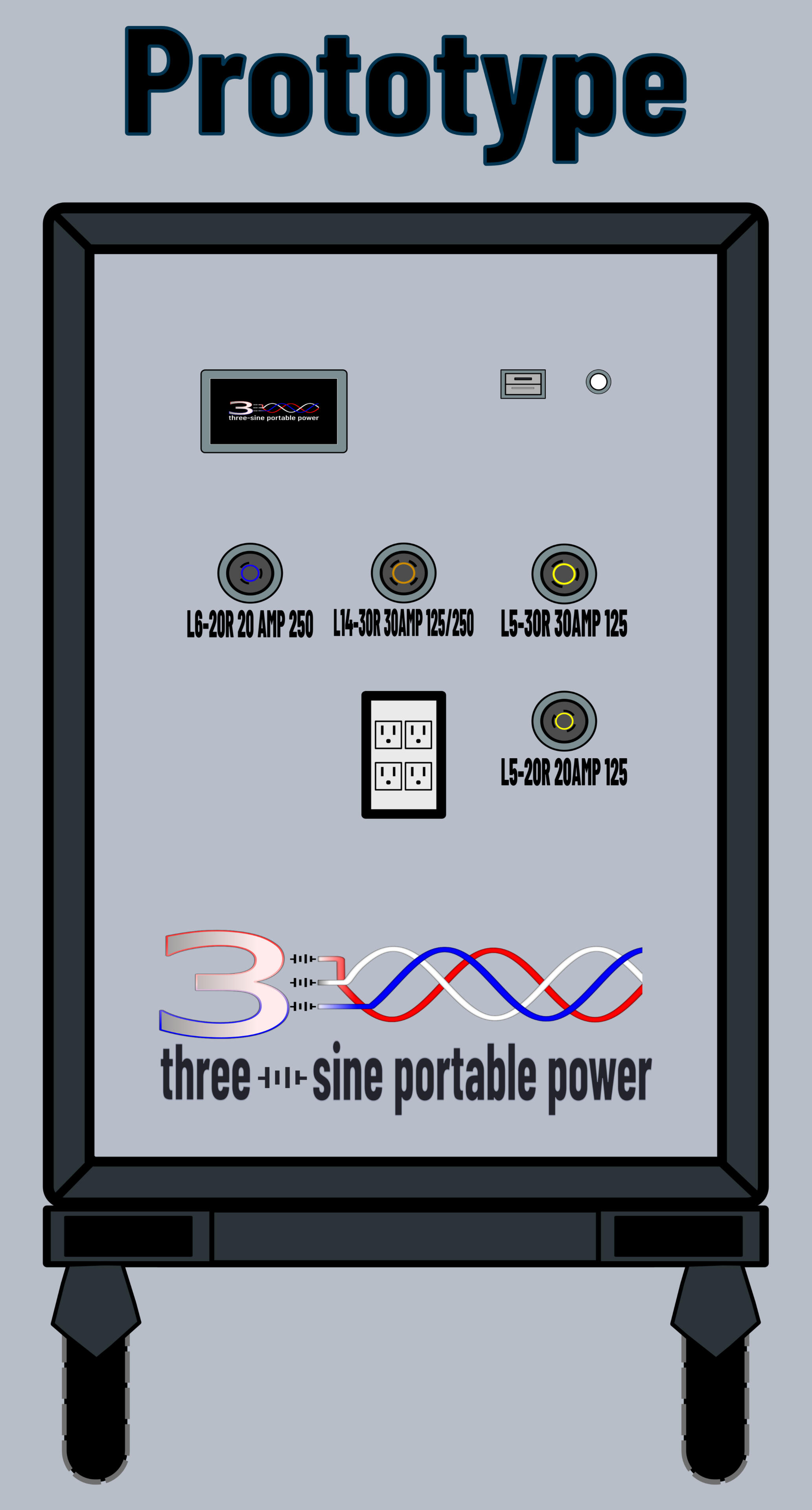
Receptacles
250/125v: L14-30R
250v: L6-20R
125v: L5-30R | L5-20R
2 X GFCI Gang8 Poles Customizable
Recommended Battery Module: BM-30
5" LCD | USB-A | USB-C
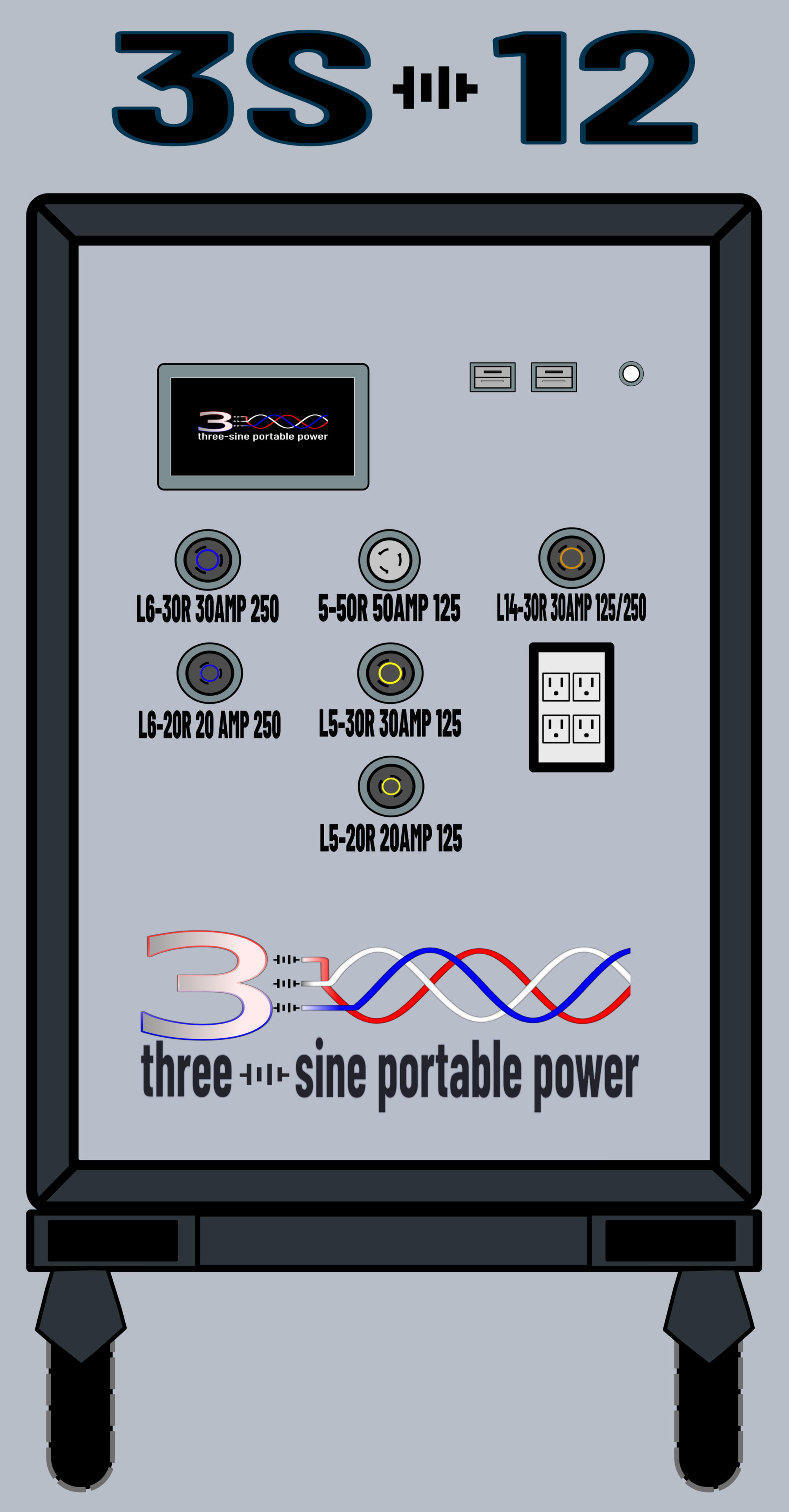
Receptacles
250/125v: L14-30R
250v: L6-30R | L6-20R
125v: 5-50R | L5-30R | L5-20R
2 X GFCI Gang12 Poles Customizable
Recommended Battery Module: BM-30
7" LCD | 2 X USB-A | 2 X USB-C | 11kW Soft Start
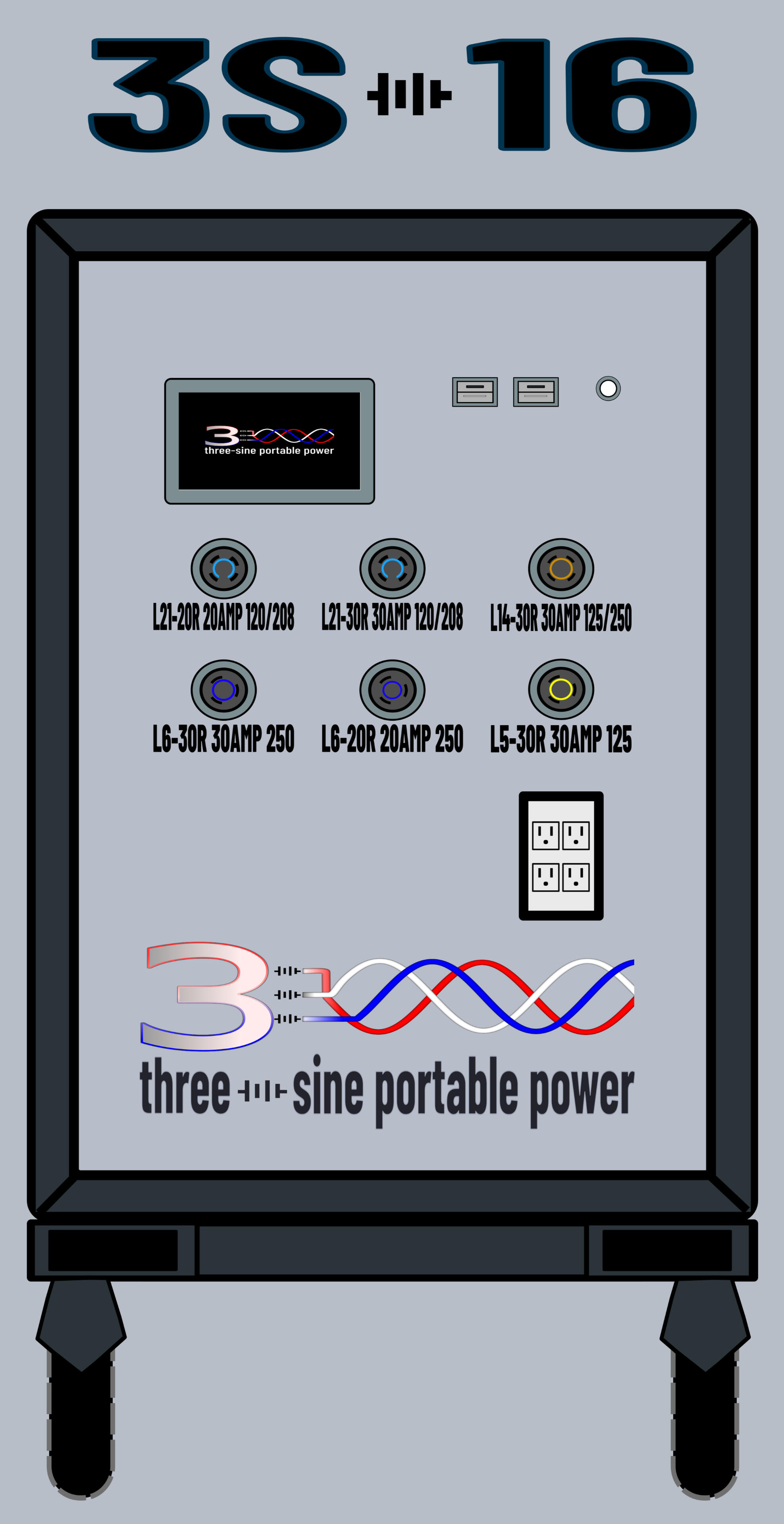
Receptacles
208v 3-phase:
L21-20R | L21-30R
250/125v: L14-30R
250v: L6-30R | L6-20R
125v: L5-30R
2 X GFCI Gang16 Poles Customizable
Recommended Battery Module: BM-60
7" LCD | 2 X USB-A | 2 X USB-C | 18 kW Soft Start
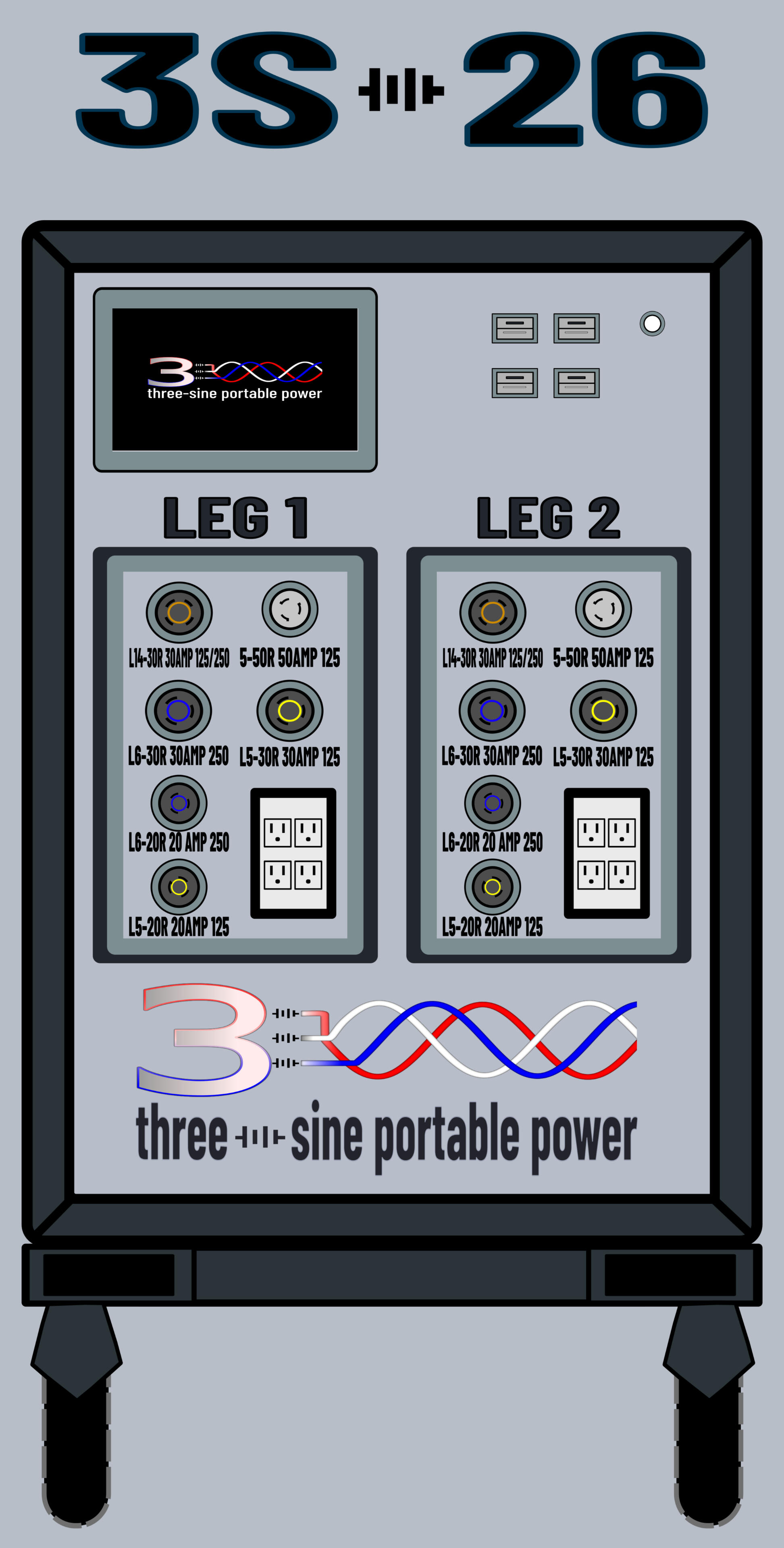
Receptacles
250/125v: 2 X L14-30R
250v 2 X L6-30R | L6-20R
125v 2 X 5-50R | L5-30R | L5-20R
4 X GFCI Single Gang24 Poles Customizable
Recommended Battery Module: BM-60
10" LCD | 4 X USB-A | 4 X USB-C | 2 X 11 kW Soft Start
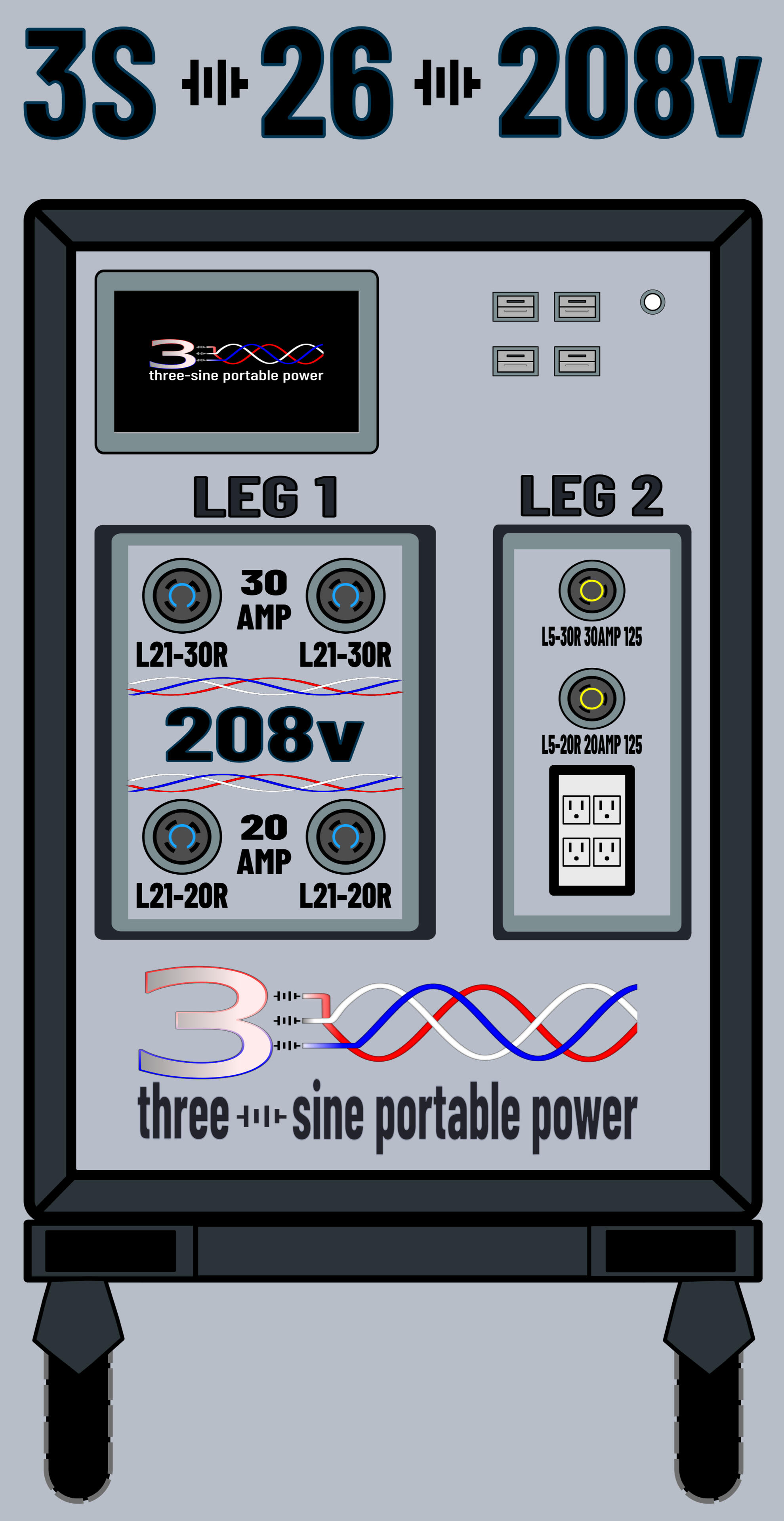
Receptacles
208v 3-phase:
2 X L21-30R
2 X L21-20R
125v single phase:
L5-30R | L5-20R
2 X GFCI Single Gang24 Poles Customizable
Recommended Battery Module: BM-60
10" LCD | 4 X USB-A | 4 X USB-C | 18 kW Soft Start
In trying to figure out what is possible coming from a steel and iron box on wheels that fits through door frames, we had to get a little creative under the hood. The base 3S-26 model achieves its max 26 kW output via dueling 13 kW inversion systems. Each system's load is monitored on the unit's LCD.The 3S-26-208v runs an imbalanced dueling inversion system. Leg 1 delivers up to 19.5 kW of 208-volt 3-phase through L21 series twist lock receptacles. Leg 2 delivers up to 6.5 kW of 120-volt single phase through L5 series twist locks and GFCI gang wall outlets.Each leg of a 3S-26 or 3S-26-208v can be run simultaneously without a transformer or user operation. The LCD display contains multiple settings for monitoring your tool and equipment load. A Spanish language display setting is available to the operator.The 3S-26-208v is ships to you ready to provide up to 19.5 kW of 3-phase and 6.5 kW of single phase once you unstrap it from the pallet. Unless specified by you, a 3S-16 Power Station will be delivered ready to provide up to 16.5 kW of split and single phase power. The 3-phase conversion process is a simple menu selection in the station's LCD display. The display and 3-Phase menu selection are detailed in the station's owner's manual.
208-Volt 3-Phase and NEMA Compliance
The acceptable voltage structures for induction motors are indicated by the engine's voltage specification as shown in it's operations manual, webpage, and on the physical spec plate affixed to every commercial tool and industrial equipment model in existence. The most common voltage specification given for light-duty 3-phase tool and equipment is 230v. The number is purposeful.The National Association of Electrical Manufacturers builds the standards that drive specifications in every commercial electrical system in America. Compliant voltage structures can be within +/- 10% of the stated specification. Low voltage 3-phase power pulled from the grid is produced in a 208-volt structure (208-volt line-to-line, 120-volt line-to-neutral). To ensure the tool can be run from grid power, voltage architecture is designed around the 230v specification (207v-253v tolerance).
When sourcing power for your 230v 3-phase tool or equipment, cord length is more impactful to engine use and lifespan than voltage structure. Three-Sine Portable Power Station's are not just providing amps silently and without emissions -- they are coming from 20-feet away -- anywhere you need to be on site. On the LOAD PROFILES page, we go into greater detail on why long cords give your tool more work than it was designed for, and shortens its lifespan.
BATTERY MODULES
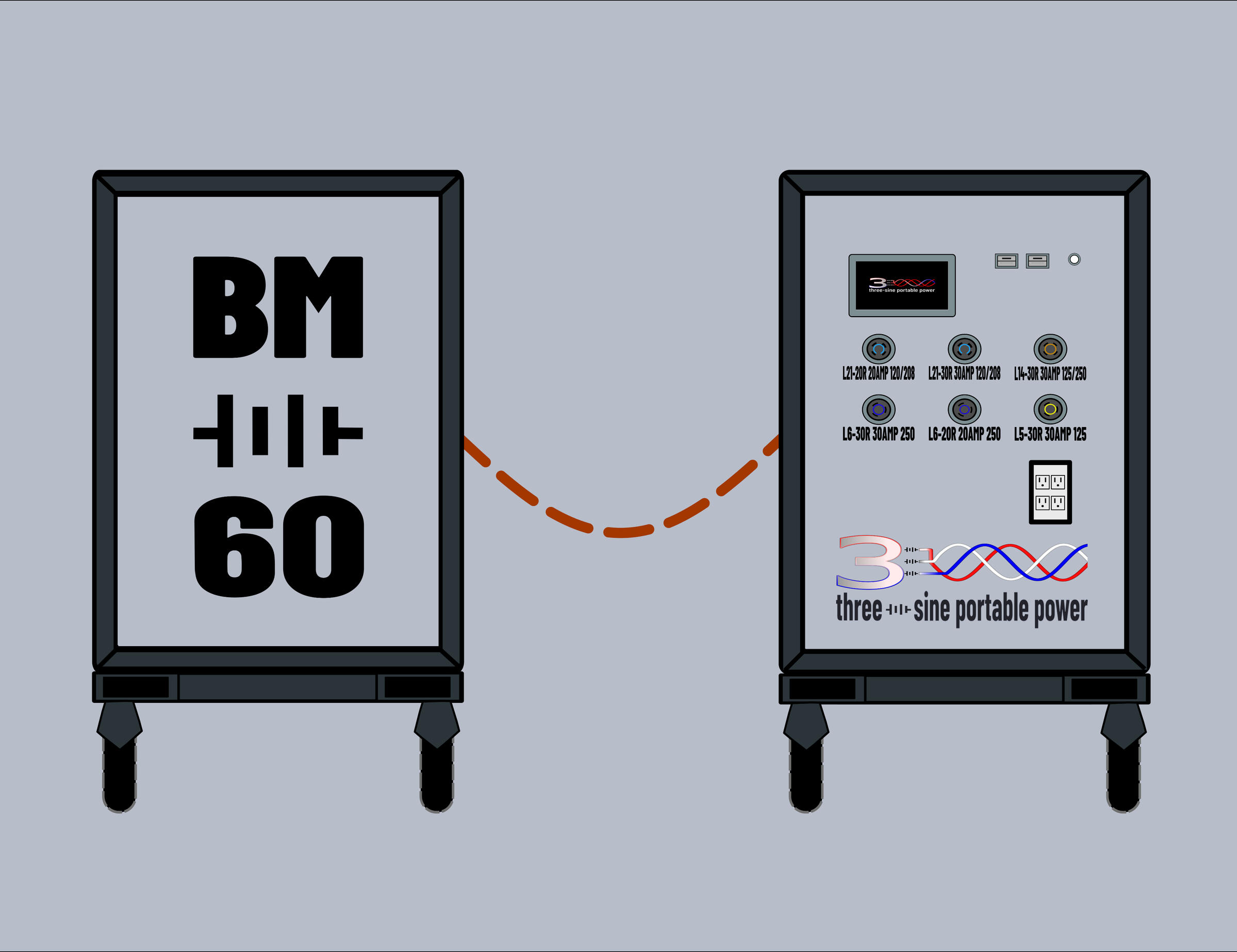
Three-Sine Battery Modules are simple products. Steel and iron boxes packed with lithium, iron, and phosphate voltage cells with Anderson 350 DC ports for connecting to base units.Keeping with the Three-Sine product philosophy, these simple units provide enormous value to contractors who build strategies around them.10, 30, and 60 kWh worth of LFP cells that immediately flood DC power through the distribution network where it can be inverted to alternating current, and made useful by your crew.BM units don't just add runtime. On the OUTPUT BOOSTS page, we lay out how Three-Sine Battery Modules expand both the kWh and max kW output specifications for Three-Sine Power Stations.
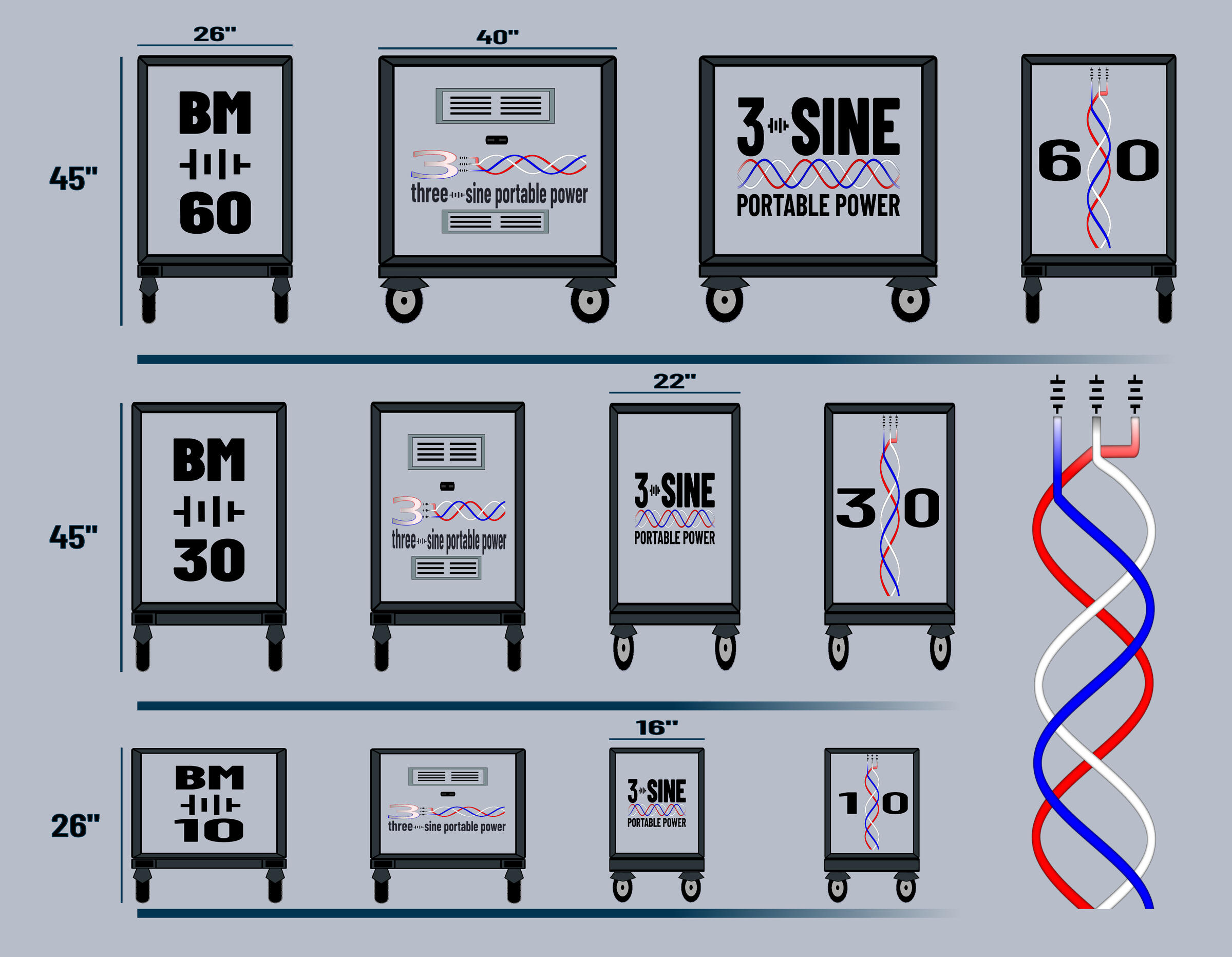
Dimensional layout of the Three-Sine Portable Power Battery Module line. Connection ports are located just below the ventilation on the broadside of every Three-Sine Portable Power product.
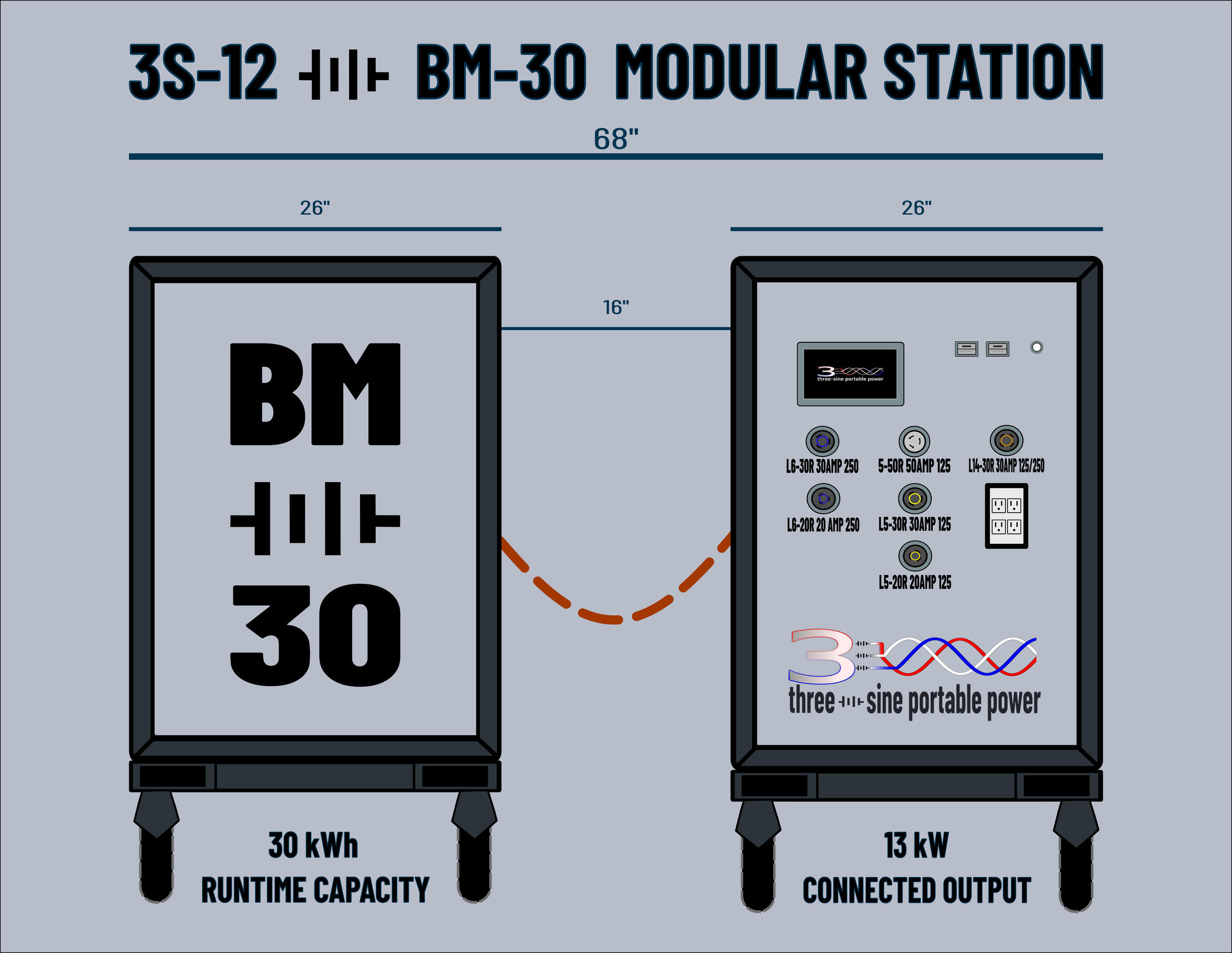
A Three-Sine Portable Power modular connected system demonstrated through a 3S-12 Power Station and BM-30 Battery Module. Shown system capacity: 13 kW max output | 51.20 kWh runtime capacity.
The measurements drive home the benefits of the modular design. In a space fewer than 6-feet wide and 4-feet deep, a connected system can output 108 max amps of 120-volt or 54 max amps of 240-volt power. Conventional fleets can split 40 amps continuously -- for a full workday.
MAX OUTPUT BOOSTS
A Prototype, 3S-12, and 3S-16's rated max kW output is restricted by the DC power distribution architecture. This is a necessary safety feature built into the system to protect the ultimate asset of your life. The enormous battery banks of the 3S-26 and 3S-26-208v allow for those base stations to achieve max system output without modification. In the other Three-Sine stations, adding battery module capacity safely allows for additional AC output from the inversion system and expands the system specifications.Connecting to a BM unit fundamentally changes the system's capabilities. In the tables below, the detail on how max kW output and kWh runtime are expanded through a connected system are shown. This brings to light the full capabilities of Three-Sine Portable Power products.
BM-10 Module Specification Expansion
| 3-Sine | Base kW Output | Base kWh Runtime | kW Boost | Connected kWh | New kW Output | New kWh Runtime* |
|---|---|---|---|---|---|---|
| Prototype | 8 kW | 15 kWh | 2 kW | 10 kWh | 10 kW | 25.6 kWh |
| 3S-12 | 12 kW | 20 kWh | 1 kW | 10 kWh | 13 kW | 30.72 kWh |
| 3S-16 | 16.5 kW | 30 kWh | 2 kW | 10 kWh | 18.5 kW | 40.96 kWh |
| 3S-26 | 26 kW | 40 kWh | -- | 10 kWh | 26 kW | 51.2 kWh |
BM-30 Module Specification Expansion
| 3-Sine | Base kW Output | Base kWh Runtime | kW Boost | Connected kWh | New kW Output | New kWh Runtime* |
|---|---|---|---|---|---|---|
| Prototype | 8 kW | 15 kWh | 5 kW | 30 kWh | 13 kW | 46.08 kWh |
| 3S-12 | 12 kW | 20 kWh | 1 kW | 30 kWh | 13 kW | 51.2 kWh |
| 3S-16 | 16.5 kW | 30 kWh | 3 kW | 30 kWh | 19.5 kW | 61.44 kWh |
| 3S-26 | 26 kW | 40 kWh | -- | 30 kWh | 26 kW | 71.68 kWh |
BM-60 Module Specification Expansion
| 3-Sine | Base kW Output | Base kWh Runtime | kW Boost | Connected kWh | New kW Output | New kWh Runtime* |
|---|---|---|---|---|---|---|
| Prototype | 8 kW | 15 kWh | 5 kW | 60 kWh | 13 kW | 76.8 kWh |
| 3S-12 | 12 kW | 20 kWh | 1 kW | 60 kWh | 13 kW | 81.92 kWh |
| 3S-16 | 16.5 kW | 30 kWh | 3 kW | 60 kWh | 19.5 kW | 92.16 kWh |
| 3S-26 | 26 kW | 40 kWh | -- | 60 kW | 26 kW | 102.4 kWh |
* New spec plate kWh values shown using actual LFP pack plated kWh used for plated Three-Sine specification kWh value.
The philosophy is simple: give your crews reliable options. The Three-Sine product line delivers unprecedented battery power for its size class (26 kW split, 19.5 kW 208-volt 3-phase) so you can run your largest job site tooling, kWh capacity that will run more conventional tool fleets for a full 8-hour day, and modular add-on capacity to give you the best of both worlds.
CHARGING
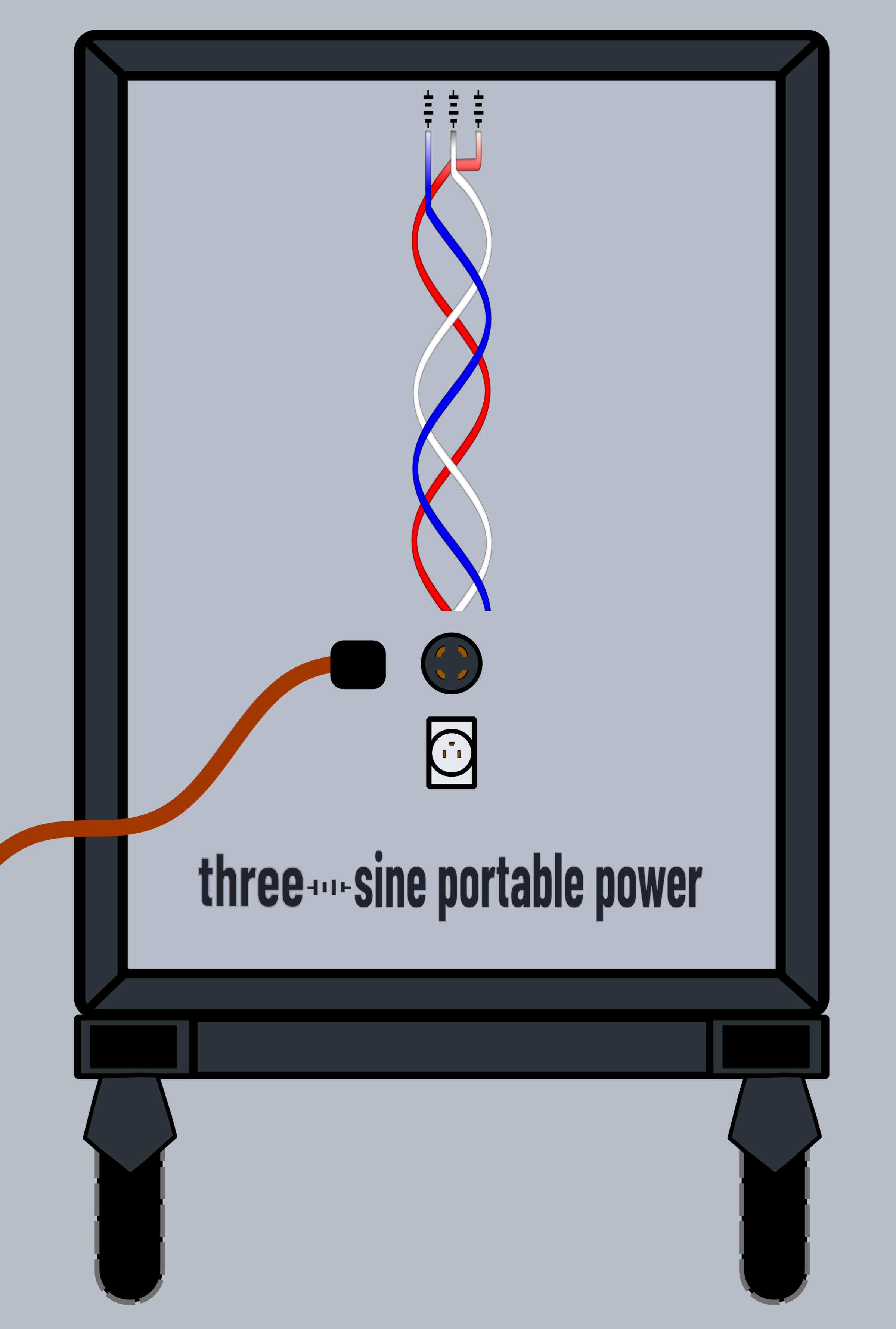
Three-Sine Portable Power Products can be charged via 240-volt, 120-volt, or solar array power sources. Power stations and BM units pull grid or generator power via inlets on the rear panel of each unit. Each Three-Sine Portable Power Station contains multiple photovoltaic (PV) solar panel connection ports. The ports are easily accessible to the user upon opening the enclosure.The 240v inlet allows for extremely manageable refill times. The 120v inlet allows charging from any location and preserves the option of a cycle-capacity-maximizing trickle charge. During assembly we program the inversion component to maximize charging capabilities for our specific LFP battery pack component.The station is capable of being operated while pulling a charge. Time until full charge is displayed in hours and minutes on the unit's LCD display.
Email [email protected] for more information on LFP cycle capacity and battery maintenance guidelines.
| Product | 120v charge | 240v charge |
|---|---|---|
| Prototype | 8 hours | 2.75 hours |
| 3S-12 | 10.5 hours | 3.5 hours |
| 3S-16 | 16 hours | 5.5 hours |
| 3S-26 | 20 hours | 7 hours |
| BM-10 | 5.5 hours | 1.75 hours |
| BM-30 | 16 hours | 5.5 hours |
| BM-60 | 32 hours | 11 hours |
+/- 15-minutes
QUALITY AND SAFETY
Three-Sine Portable Power Stations produce electricity. When 20 milliamps or greater of electrical current enters the human heart, it permanently stops working. We take this fact incredibly seriously, and every component selection was made to ensure lethal electrical shock never happens to anyone building or operating a Three-Sine Portable Power Station or Battery Module.The LFP packs rate to 7,000 cycles, and we want you to make productive use of every DC amp pulled across that lifespan. It isn't just components; it's architecture. From color coded Leviton twist locks to 1/4" thick tinned copper bus bars, quality and safety are baked into the design of every Three-Sine product.The table below details the critical choice-making that went into each station's design and why you can be confident Three-Sine Portable Power Stations will safely deliver the amps you need when and where you need them.
| Component | Factor | Description |
|---|---|---|
| Class-T Fuses | DC Surge Protection | Class-T fuses are positioned 3" from each LFP pack's positive pole as the DC system's first connection. This is the most critical safety feature on every Three-Sine product. Any potential surge amperage travels 3" and is captured by the fuse. Class-T fuses rate to 20,000 amps, which is physically impossible to be produced by the LFP packs. It is nearly a 5 X 1 safety factor at the most critical connection. |
| UL Certified Components | Safety and Reliability | The inverter component is UL 1741 certified in the US and Canada. The LFP Packs are UL 1973 Certified in US and Canada and have the additional IEC 62619/IEC 62620/CE-EMC battery pack worldwide certifications. The inverters and batteries are being used in manufacturer's specified applications as directed in each product's user manual. |
| Marine Grade Tinned Copper | Long Term Weatherproofing | All Three-Sine conduit is marine grade tinned copper, including the bus bars. Copper is tinned to withstand corrosive outdoor environments. Marine grade is the highest quality conduit available for connections that have to survive the environment with thicker jacketing protecting the runs. |
| Norlock Wedgelock Washers | Job site abuse protection | Norlock wedgelock washers are used on every DC lug connection in the system. Wedgelock washers are a two-piece set that sit on top of each other. Each side is teethed for a different purpose. The outer surface of the washer has fine teeth to reduce surface area between itself and the hex nut or the copper. The undersides mate with teeth that groove into each other when the hex nut is properly affixed. The combination allows for jostling to run through the connection while keeping the washer firmly locked into place and not have it back off the threading. A careless forklift driver could whack the broadside of the station with a fork, and the connections would hold firm because of the wedgelocks. |
| 2/0 DC Wiring | System Capacity Reliability | The DC amps are distributed to the fuses, bus bars, and inverters via 2/0 AWG wire. This is the inverter manufacturer's max wire connection gauge and is used to make sure that if you need 19.5 kW of 208-volt 3-phase; you get it. |
| 1" rubber enclosure sealing | Job site abuse protection | Each product's enclosure has its interior dimensions completely covered with 1" thick rubber padding. This is used to fire and explosion-proof the product, create the weatherproof sealing, and absorb kinetic energy from job site abuse. |
| Siemens SERIUS Soft Starter | Reliability | The soft start component protects both the engine pulling amps and the station delivering them. It is critical for handling large 208-volt inrush loads and the surges common while operating portable tools or pumping systems. |
| GFCI Load Protection | Safety | Ground Fault Circuit Interrupter (GFCI) components -- the lifesaving technology found in every home's wall outlet -- protect every AC circuit. A 3S Power Station's load center detects a trip at 5 milliamps (mA) and breaks the circuit before the life-ending 20+ mA current can enter a human body. This eliminates the possibility of lethal electrical shock at the receptacle or load center. |
| Insulated Crimped Terminals | Quality and Safety | Every AC wire connection is made through an insulated, crimped terminal. All receptacles are terminated through spade-fork's and all load center and inverter runs terminate through ferrules. Using insulated, crimped terminals eliminates any exposed copper in the entire AC system and secures every wire connection from abuse. Additionally, it eases with the product assembly process in making sure we make a proper termination -- every time. |
We build Three-Sine Power Stations to run anything within the spec plate, on any job site, for greater than 5 years.Three-Sine Portable Power will establish itself as a Tier-1 manufacturer of battery-sourced power stations -- even if the space lacks a direct competitor today. As competition enters the market, we will be the standard bearer on quality, safety, and reliability.
LOAD PROFILES
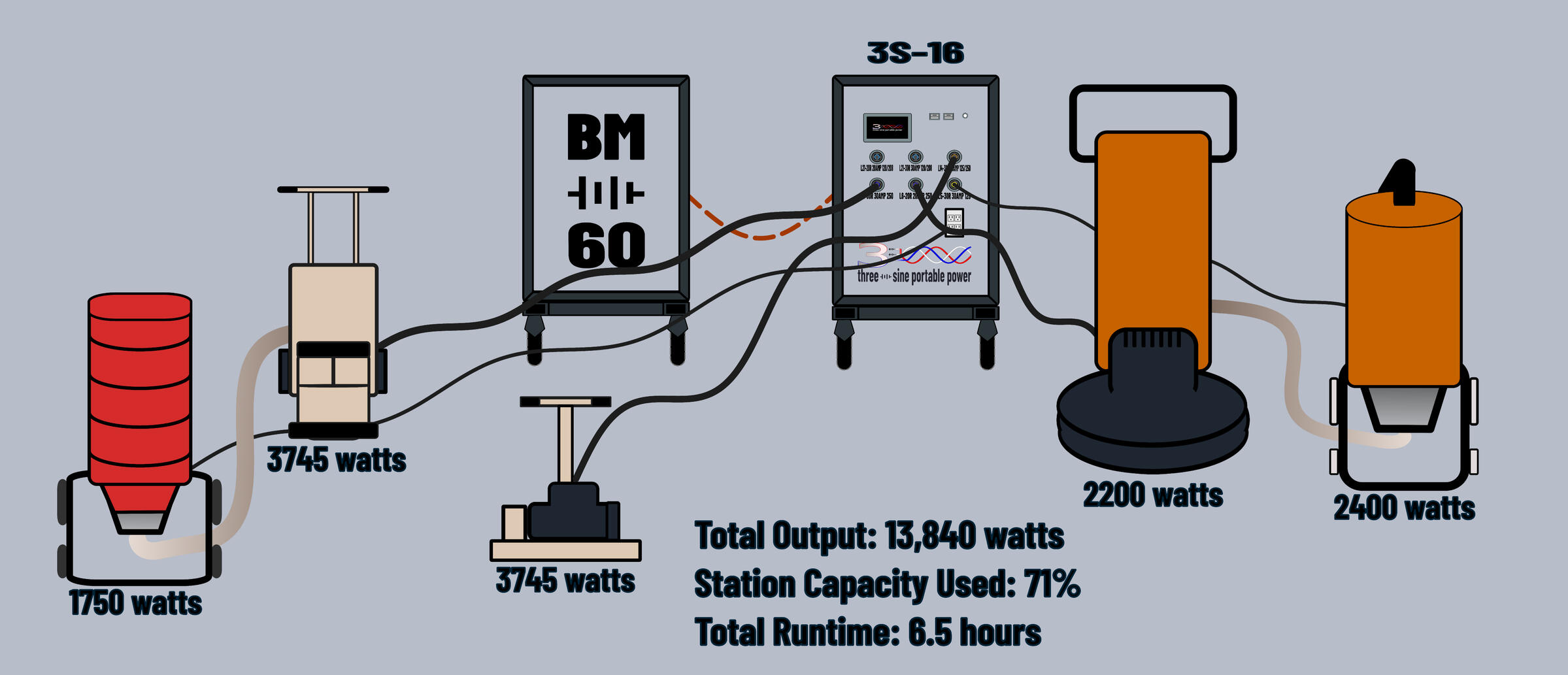
Three-Sine Portable Power Stations are virtually limitless in application within the unit's specifications. They are engineered for handling the most reactive inrush loads with low power factors and high kVA at startup. They can be used to power full buildings, large-scale sound and lighting rigs, or a fleet of 800 lb planetary concrete floor grinders.
Contractor Businesses
Commercial contractors working with concrete are ideal Three-Sine customers often facing tough site conditions with intermittent or no grid power while working in enclosed spaces. Saws, grinders, and dust-suppression long ago moved to induction motors so this work can be reliably done without emissions or noise.
Commercial flooring contractors doing surface preparation or finishing work run multiple split and 3-phase tools in tandem. The core setup of a flooring contractor consists of a concrete grinder, saw, and an industrial vacuum for dust suppression. Additional equipment with large pulls include planers, core drills, mixing stations for self leveling compounds, lighting rigs, and fans.
Tier 1 manufacturers of surface preparation and other concrete tooling include Husqvarna, EDCO, and Hilti. In the below table, Three-Sine systems are paired with common load profiles using popular tool models from Husqvarna (Hq), EDCO (Ed), and Hilti (Hi).
Three-Sine Power Stations and Battery Modules are arranged to demonstrate how the line delivers value to your business -- conventional fleets all day, raw power when you need it, capacity for both.
| 3-Sine | Load Profile | Draw | Capacity | Runtime |
|---|---|---|---|---|
| Prototype + BM-30 | Hq PG 280 120v Hq DE 120 Ed CPL-8E Ed VAC-200 Hq WL 24 | 5.5 kW | 46.08 kWh | 8.25 hours |
| 3S-12 | Hq PG 5 240v Hq DE 130 120v | 6.5 kW | 20.24 kWh | 3.1 hours |
| 3S-16 + BM-60 | Hi DD 250 Ed DS-18 Ed VAC-290 | 10 kW | 92.16 kWh | 9.2 hours |
| 3S-16* + BM-60, 3S-26 + BM-60 | Hq PG 8 S** Hq DE 130 240v X 2 Ed C-10E Port-a-Hippo X 2 Hq WL-24 X 2 | 26.65 kW | 194.56 kWh | 7.3 hours |
* Converted to 3Φ output
** 3Φ 200-240v Spec
Draw load uses continuous rating for each model
The modular system eliminates the guesswork. Build a fleet of add-on battery modules and swap them into base units in 30 seconds giving your site limitless capacity.
Eliminate the 300 feet of cord and diesel tow-behind in the parking lot from your site plans by utilizing Three-Sine stations right at your work point. Emission and noise-free 3-phase power in arms length of the tool.

Voltage Drops and Distortion
Voltage dropping due to cord length is something every contractor needs to be conscious of and plan around to protect their investment in larger tools.For a typical 3-phase tool pulling 30 amps on a 10 AWG extension cord, the voltage drop is roughly 3-5% per 100 feet. Across the distance, the sine waves begin to physically distort in size.Sine wave distortion occurring during voltage drops, is referred to as 'sag'. Distorted sine waves* -- often experienced as a constant factor for power emitted from older or lower tech generators -- are commonly referred to in the field as 'dirty power'.When distorted sine waves meet your tool, additional wattage is needed to re-align the waves and meet the engine's internal AC architecture (three hots, 120 degrees offset in 3-phase tooling); increasing the system's total kVA.EDCO tool specifications standardize on 100 ft. cord lengths due to damage caused by the sine waves sagging as the distance between source and tool increases. Not only are engines receiving fewer amps, they require more effort than designed for to get them.For the largest contractors, being left with zero options on cord length has a meaningful impact on the depreciation table of the tool fleet. Incorporating Three-Sine Stations into your business model doesn't just give your crew options, it allows the accounting department some breathing room, and frees up dollars for reinvestment.240 volt cords longer than 200 feet drop into 3-phase voltage structures similar to the ones produced by 3S-16 and 3S-26-208v Three-Sine Stations; while delivering amperage with less efficiency due to sag.
A 230-volt specified 3-phase concrete grinder with a 50-ft cord plugged into a Three-Sine Power Station producing 208v 3-phase, is receiving more amperage than that grinder when plugged into a 240 volt power source 300 feet away -- and is ONLY using those amps to grind concrete.
The floors you build get larger each year. That means the center extends further from an outside power source during grid outages. Terminate the issue, grow your margins, and put long term value back into your business with Three-Sine Portable Power.
*Total harmonic distortion on all 3-Sine products: 2-3% | IEEE 519 Grid Standard: ≤5% | Typical Rental Gen: 12%
THE FUTURE
Three-Sine Portable Power was incorporated in May of 2026 and this is only the beginning. There aren't products like Three-Sine Portable Power Stations and Battery Modules on the market, and we are immensely proud to build and offer them. 26 kW of split and 19.5 kW of 208v 3-phase from batteries on wheels through doors is unprecedented.It isn't why this company was started.3-phase 240 and 480 volt mobile systems are achievable and Three-Sine aims to achieve it. The products are a dedicated engineering project from realization. We are engaged in that project, and we will bring these systems to market.Three-Sine Portable Power can't achieve our goals without customers who are dedicated to our development, and we can't force that to happen. Offering reliable product that works without bullshit is necessary to our survival. We back every product with a 1-year warranty from point of customer receipt. Building relationships with our customers is foundational to our business model.When we say call us to talk about your tool fleet, or FaceTime us to troubleshoot the LCD screen, we mean it.
This is what the future looks like to us: You and your crew have spent the day grinding and cutting the floor of an Amazon warehouse. A Three-Sine system gave you 30 kW of 3-phase and 20 kW of split-phase, simultaneously -- all day long. You increase your sq footage and number of passes by 30% because your power source moved with your team as a silent member of it, ensuring the entire fleet has everything it needs. When you needed to switch between large tooling, you didn't need 100's of ft of cord and a transformer because all standard RMS 3-phase voltage values were menu items in the unit's LCD - ten feet from your setup. You refill 20% at the Tesla Supercharge station in the Wawa parking lot while you wait for your hoagie on the way back to the shop. Life is good.We want this to be available to you in 2028. We can't wait to get there. What is possible from a steel and iron box on wheels that fits through doors? We are going to find out together.
SINE WAVE DISTORTION
Sine wave distortion is a serious issue for a contractor working in large enclosed spaces with portable tooling. Over the last decade, a lot of development has successfully gone into technologies for producing portable sine waves from all sources.Manufacturers like Generac have led the way here and make great products currently matching Three-Sine's 2-3% THD. The problem is twofold:1. The technology didn't exist 10 years ago so even tier-1 manufacturers produce more distorted waves in older models which are commonly rented, or in your fleet currently.2. Production at the source is meaningless when you are 500 feet away from it.This stuff is technical and complicated. With the below imagery, Three-Sine hopes to establish that we live and breath electricity. We are laser-focused on solving niche, but hugely consequential problems like sag damage for contractors, production crews, and anyone who might come across the issue.What you are seeing below are 3 sinusoidal waves of electrons. This is what 3-phase power physically looks like within its voltage structure; 3 hot legs (L1, L2, L3) 120 degrees offset moving simultaneously up and down and in orbit around a central axis point.Single-phase 120-volt power (like what comes from your homes wall outlet) is what is displayed by clicking the 'Single Phase' button. It is created by a single hot leg (L1) producing one sine wave that peaks and valleys within and around its 120-volt structure. 240-volt structures are created by adding an additional hot leg (L2) offset by 180 degrees to L1. Each leg finds a contact when the waves reach their destination.When you see standardized numbers like 120, 208, 240, and 480 as voltage structure sizes, what is being given is the root mean squared (RMS) value. That is the mean diameter of the structure across the length of its distribution (your tool's cord). When the electricity meets the tool's engine, the contacts are spaced to accept sine waves at standard points depending on the structure.This is where the damage occurs.Perfect sine waves are theoretical only so the architecture expects distortion. However, beyond a certain threshold the engine needs to enact a mechanism to physically correct the wave's positioning. This operation increases the kilovolt-amperes (kVA) in the system which is the measurement of apparent power.Every AC electrical system will have two governing characteristics regarding output.1 Kilowatts of work produced. This is the headline constant output rating (11,200 watts on a Husqvarna PG 8 S planetary grinder).2 Total kVA. This number tells you the entire wattage output of the system and includes apparent factors like sine wave correction in its calculation.kVA can never be less than kW, but the larger the positive divergence, the less efficient your tool is running. Distortion is so consequential because it is a constant factor -- every single electron needs to have its positioning corrected.Select a power source to see the harmonic distortion visualized at various tiers. The visual should assist in helping understand what is physically happening at the contact points of your tool's engine.
If some of these words made sense and others didn't, but you are still curious; please email [email protected] or call us. Let's talk about exactly what you are running, and we can break down the technical stuff piece-by-piece centered around your operations. We are here to help!
CUSTOMIZATIONS
receptacles
Three-Sine Portable Power has domain expertise in battery capacity, DC power distribution, DC:AC inversion, and delivering AC power to receptacles in a construction rated system that will stand up to job site hell.We have zero knowledge or expertise in exactly how you successfully built and run your business. We want your Three-Sine product to be purpose-built by you to run the specific tool and equipment fleet you have invested in.Design a custom outlet suite for each 3S unit you purchase. Select the receptacles that work for you and fill 8 poles on the load center of a Prototype, 12 poles on a 3S-12, 16 poles on a 3S-16, or 24 poles on 3S-26 models. Include your selection when placing your order, and you will receive a mock-up image of the front face of your three-sine power station that will be shipped to you.There is not an additional charge for this.You strategize your job site. What tools run where, and when. Optimize that strategy with Three-Sine customizable receptacle suiting.
| Receptacle | Voltage | Amps | Poles |
|---|---|---|---|
| GFCI Gang | 110 | 20 | 1 |
| L5-15R | 125 | 15 | 1 |
| L5-20R | 125 | 20 | 1 |
| L5-30R | 125 | 30 | 1 |
| 5-50R | 125 | 50 | 1 |
| L6-20R | 250 | 20 | 2 |
| L6-30R | 250 | 30 | 2 |
| 6-50R | 250 | 50 | 2 |
| L14-20R | 250/125 | 20 | 2 |
| L14-30R | 250/125 | 30 | 2 |
| 14-50R | 250/125 | 50 | 2 |
| L21-20R | 208* | 20 | 3 |
| L21-30R | 208* | 30 | 3 |
| 18-50R | 208* | 50 | 3 |
*3Φ
theft protection and branding
Three-Sine also understands the importance of protecting your equipment from theft, and visually representing your business through branding.Each Three-Sine Portable Power product comes with an Apple AirTag affixed to an inaccessible location within the enclosure. The AirTag will pair with any iPhone, and can be used to track the product's location, and produce other data useful for recovering a stolen power station or battery module.Additionally, we will print your company's name and/or logo prominently on the broadside of each Power Station or Battery Module at no additional cost.Email an image file of your company's branding to [email protected], and we will reply with a mock-up of what your custom-built station will look like when it runs your tools.
GPS Tracking plus visual representation of ownership, nearly eliminates the possibility your Three-Sine Portable Power Station or Battery Module will ever be lost, misused, or successfully stolen.
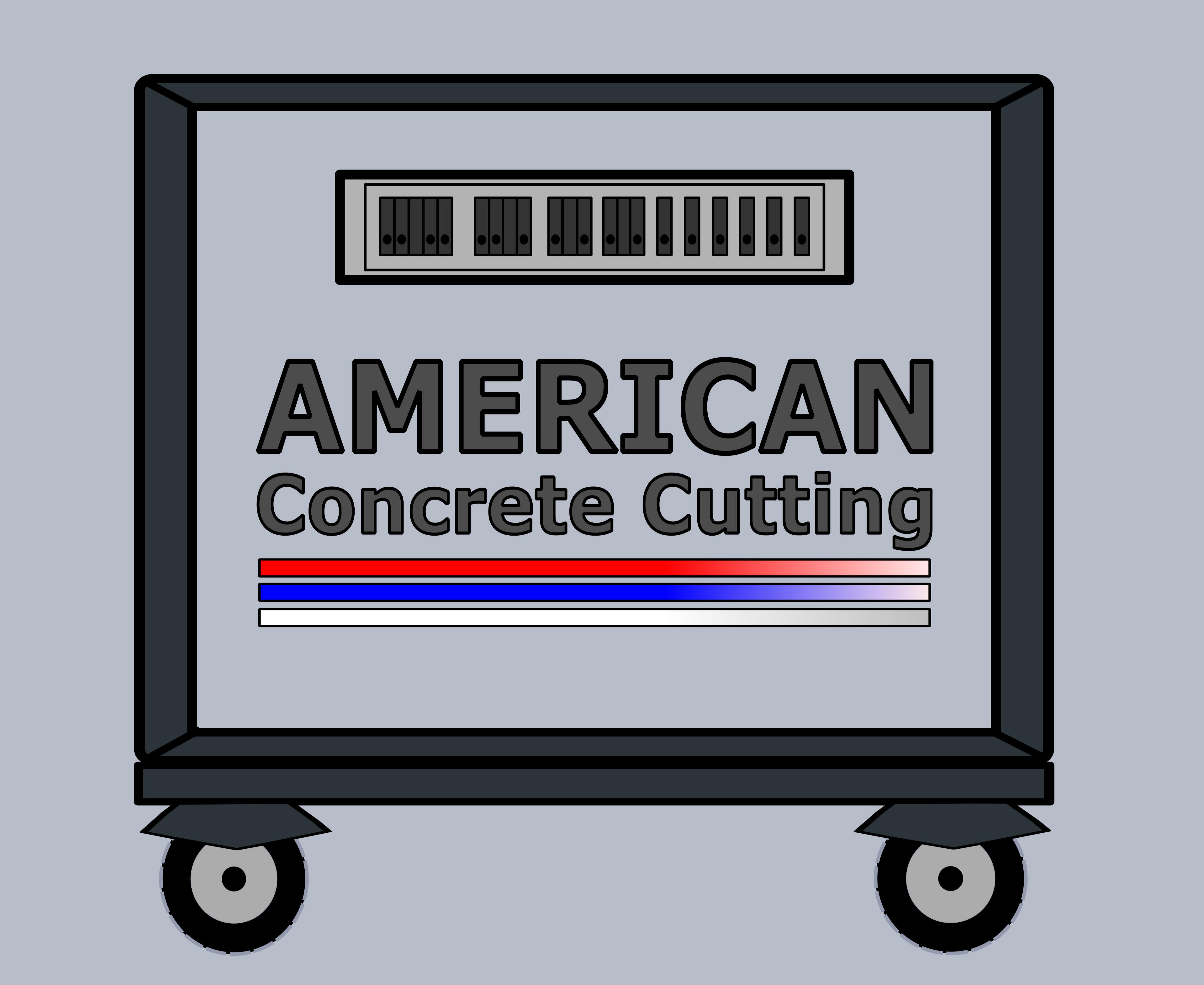
Interested in displaying personalized artwork? Awesome! If you own it or it isn't trademarked, and a 10-year-old can look at it, we'll print it!
CONTACT US
We understand these are significant purchases. When you contact us we will be responsive, and we are dedicated to building strong relationships with our customers. Three-sine products are backed with a 1-year warranty from the point of customer receipt.Three-sine power stations can potentially change the way you run your business, and it is our job to prove that to you.
Every Three-Sine Portable Power Station or Battery Module is built as ordered and carries a 4-6 week lead time. We intend to close this gap before 2027, but right now we are a small company obsessed with perfection. Every product on the site is available to be ordered in one of the following ways:
Call 215-309-9277 and speak with us directly
Email your PO to [email protected]
Complete the below intake form with your PO.
Do you need to see it run something specific? Call and ask about demonstrations.
Do you just have a general question? Awesome! Let us know how we can help.